Showcase
Discover projects built with Intlayer
Back to Showcase Gallery
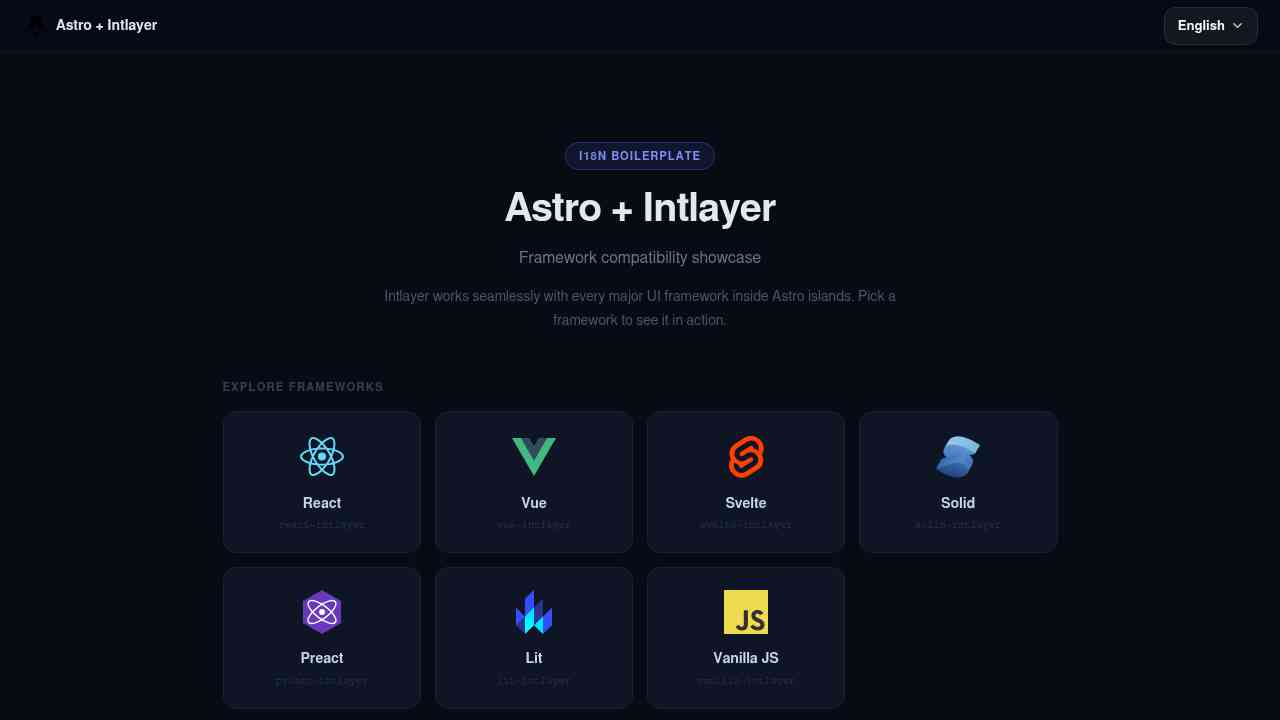
Intlayer Astro template
Experience the power of Astro combined with Intlayer for effortless internationalization.
PublishedApril 25, 2026
Last ScanApril 25, 2026
Intlayer Version^8.7.7
Rate this project
1
Libraries Used
intlayer
v^8.7.7
react-intlayer
v^8.7.7
svelte-intlayer
v^8.7.7
vue-intlayer
v^8.7.7
More Projects
Explore other projects that use Intlayer for their internationalization.
SEO & Global Reach
Technical analysis of internationalization best practices.
Lang tag:
en
The
lang attribute on the <html> tag declares the primary language of the page. This helps search engines and browsers understand the content language.Why it matters: Essential for SEO and accessibility. Screen readers use it to pronounce content correctly.
HTML dir:
ltr
The
dir attribute on the <html> tag specifies the text directionality of the content. This is essential for languages that are written right-to-left (RTL).Why it matters: Critical for proper rendering of RTL languages like Arabic, Hebrew, Persian, and Urdu. Improves readability and user experience.
Values:
ltr (left-to-right), rtl (right-to-left), or auto.Current locale:
The detected locale of the current page based on the HTML
lang attribute. This is the language code that represents the page content.Examples:
en, fr, de, es-MX, pt-BRNote: Should match one of the hreflang values and be a valid ISO 639-1 language code.
og:locale:
The
og:locale meta tag tells social networks (Facebook, LinkedIn…) the language of the shared page. Without it, link previews assume en_US. It should match the <html lang> value.Hreflangs:
Hreflang links tell search engines about alternative language versions of your page. They prevent duplicate content issues and help serve the right language to users.
Best practice: Include an
x-default for users whose language you don't support.x-default:
Indicates whether the page includes an
x-default hreflang tag. This tag specifies a default/fallback page for users whose language preferences don't match any specific hreflang.Best practice: Always include
x-default in multilingual sites. It should point to a language selector page or your primary language version.
Why it matters: Ensures international users get directed to an appropriate page even if their language isn't specifically supported.Hreflang return links:
Each hreflang alternate is fetched to verify that it answers with a
200 (no redirect), links back to this page with its own hreflang tags, and declares the expected language.Why: search engines ignore hreflang pairs without a return link.
Canonical:
A canonical tag tells search engines which version of a URL is the "master" copy. Critical for avoiding duplicate content penalties in multilingual sites.
Best practice: Each language version should have its own canonical pointing to itself, not to another language.
Localized links:
Checks if the site contains links to localized content. This indicates proper internal linking between language versions.
Good practice: Cross-link between language versions using hreflang alternates and language switchers.
Helps with: User navigation between languages and search engine discovery of all versions.
All anchors localized:
Checks if all internal links on the page include a locale prefix in their path (e.g.,
/en/, /fr/). This is crucial for proper language routing.Why it matters: Ensures consistent language experience and proper URL structure for multilingual sites.
Language switcher:
Checks that the page contains crawlable
<a href> links to its other language versions (a language switcher).Why: without them, search engines only discover the translations through hreflang tags, and users cannot switch language.
robots.txt
Accessible:
The
robots.txt file is a text file that tells search engine crawlers which pages or sections of your website they can or cannot access.Why it matters: Essential for controlling crawler access and protecting sensitive areas while allowing important content to be indexed.
Disallow w/o locale alternates:
Paths that are disallowed in
robots.txt but have no equivalent locale-specific versions. This can indicate incomplete internationalization.Example issue: If
/admin/ is disallowed but there's no /en/admin/, /fr/admin/, etc., it may suggest the site structure doesn't consistently use locale prefixes.Best practice: Ensure all disallowed paths have locale equivalents if your site uses URL-based localization.
sitemap.xml
URLs discovered:
The total number of URLs found in your
sitemap.xml file(s). Sitemaps help search engines discover and index all pages on your website.Good practice: Keep sitemaps up-to-date and organized. For large sites, use sitemap index files that reference multiple sitemaps.
Impact: More discovered URLs mean better coverage for search engine indexing.
Alternates present:
Indicates whether your sitemap includes
<xhtml:link> elements with alternate language versions. This tells search engines about all language variations of each page.Best practice: Include alternates in sitemap to help search engines understand the relationship between language versions.
x-default present:
The
x-default hreflang tag specifies a default page for users whose language isn't explicitly targeted. It's a fallback for international users.Best practice: Point
x-default to a language selector page or your most universal language version (often English).
Important: Every set of hreflang alternates should include an x-default.